 800.883.8290
You found a property in Silver Spring that looks promising. The numbers seem to work. But a nagging question keeps you up at night: what are you missing? That fear of the unknown kills more first flips than bad deals ever will. After funding thousands of loans since 2007, I have watched first-time flippers succeed and fail in Montgomery County. The difference rarely comes down to finding the perfect property. It comes down to preparation.
This checklist covers everything you need to know before your first Montgomery County flip. From realistic profit expectations to permits, financing, contractors, and exit strategies. Consider this your roadmap through a market that rewards the prepared and punishes those who wing it.
What This Guide Covers
- Realistic Profit Expectations in Montgomery County
- Best Neighborhoods for Your First Flip
- Permits, Inspections, and Local Rules
- How Much Cash You Actually Need
- Analyzing Deals and Calculating ARV
- Financing Options for First-Time Flippers
- Building Your Team
- Renovation Priorities That Matter to Buyers
- Holding Costs, Taxes, and Common Mistakes
- Exit Strategies When Plans Change
- The Complete First-Time Flipper Checklist
Realistic Profit Expectations in Montgomery County
Maryland flippers averaged $157,650 in gross profit per flip in late 2024. That figure sounds incredible until you realize it represents experienced operators who have refined their systems over dozens of deals. For context, the national average sits around $70,250. Maryland is legitimately one of the best markets in the country for flipping.
But gross profit is not net profit. You still need to subtract holding costs, financing expenses, closing costs on both ends, agent commissions, and taxes. A first-time flipper in Montgomery County should realistically expect net profits between $20,000 and $45,000 per property. That assumes a three to five month timeline, accurate renovation estimates, and minimal surprises.
Your first flip will likely yield less than subsequent deals. You will pay premium prices for contractor services because you lack relationships. Your timeline will stretch longer than planned. You will miss cost-saving opportunities that experienced flippers spot immediately. Accept this reality now and treat your first project as expensive education that ALSO pays you.
The median home value in Montgomery County exceeds $650,000 in many neighborhoods. Viable flip opportunities typically exist in the $270,000 to $400,000 range. After renovation, these properties command $440,000 to over $600,000. The spread is there if you execute properly.
Best Neighborhoods for Your First Flip
Montgomery County real estate is intensely hyper-local. Market dynamics vary dramatically between neighborhoods and even between different blocks within the same neighborhood. What works in Bethesda could fail completely in Wheaton. You need to understand micro-markets before committing capital.
Takoma Park leads the county with double-digit price growth, making it an appreciating market. But premium pricing may limit accessibility for first-time investors with constrained capital. Silver Spring, Chevy Chase, and Bethesda demonstrate steady appreciation with modest but healthy gains. These walkable, established communities attract young professionals and families with strong purchasing power.
Silver Spring deserves particular attention for first-time flippers. It offers more affordable entry points compared to nearby D.C. suburbs while maintaining strong appreciation fundamentals. The buyer pool remains consistent and the rental demand stays robust if you need to pivot strategies.
Frederick represents an emerging opportunity if you want better risk-adjusted returns. The city combines relative affordability with compelling growth catalysts. A planned downtown hotel and conference center backed by state funding is coming. Lucas Village public housing is being demolished and replaced with 248 new units. The employment base is diversifying into biotech, healthcare, and education. These concrete developments provide downside protection for flip investments.
What to Look For in Any Neighborhood
Prioritize areas with clear evidence of institutional investment and demographic strength. Communities with major corporate relocations, university expansion, or government investment demonstrate sustainability beyond speculative cycles. Avoid properties in declining neighborhoods or those dependent on luxury market demand.
Spend significant time physically present in target neighborhoods. Drive through at different times of day and week. Observe foot traffic, storefront activity, and overall vitality. A neighborhood that appears strong on paper but shows signs of decline on the ground warrants caution regardless of what the numbers say.
Permits, Inspections, and Local Rules
Montgomery County’s permitting system operates as both a critical safeguard and a potential source of delays. Understanding which improvements require permits prevents costly rework and schedule disruptions. The Department of Permitting Services distinguishes between work homeowners may perform themselves and work requiring licensed contractors.
Residential contractors must obtain permits for structural modifications, electrical work, plumbing installations, HVAC system replacements, and any work involving additions or major alterations. Projects that appear cosmetic often do not require permits. But any work involving building systems, load-bearing elements, or square footage changes absolutely requires formal approval.
When a permit is issued, a Notice of Required Residential Inspections gets attached to approved plans. The permit must remain on site throughout construction, clearly marked with the lot number or address. Montgomery County residential inspectors are cross-trained in building, mechanical, and electrical inspections. Close-in and final inspections for building, electrical, and mechanical must be scheduled simultaneously for the same date.
Critical Steps Before Breaking Ground
Contact Montgomery County’s 811 Underground Damage Prevention Service at least two days before any digging. Maryland’s High Voltage Line Act prohibits any object from getting closer than ten feet to high voltage power lines. This safety step prevents project shutdowns and keeps everyone alive.
Consult with the Department of Permitting Services before closing on any property. Understand the specific permit requirements and associated fees for your planned improvements. Allocate approximately 5 to 10 percent of your total renovation budget for permit costs and unexpected code-required upgrades. First-time flippers frequently underestimate permitting timelines. Delays of four to twelve weeks happen more often than you would like.
How Much Cash You Actually Need
The amount of cash required extends far beyond your down payment. First-time flippers frequently underestimate total capital requirements, then find themselves strapped mid-project when unexpected issues arise. Understanding the complete capital picture before committing prevents disasters.
Total capital breaks into four categories: acquisition costs, renovation expenses, holding costs, and reserves. For a property purchased at $250,000 with 30 percent down, acquisition costs total approximately $75,000 for down payment plus $10,000 to $15,000 for closing costs, title insurance, lender fees, and miscellaneous expenses. Hard money lenders in Maryland typically charge 2 to 3 percent origination points, adding another $5,000 to $7,500.
Renovation Budget Reality
A mid-range renovation for a typical Montgomery County property averages $35,000 to $60,000 depending on property condition and scope. Kitchen renovations typically cost $40,000 to $72,000 for a mid-range to upscale remodel. Bathroom renovations run $24,000 to $57,000 depending on finish level. Beyond kitchen and bathroom work, exterior curb appeal projects consistently deliver the highest return on investment, often exceeding 90 percent.
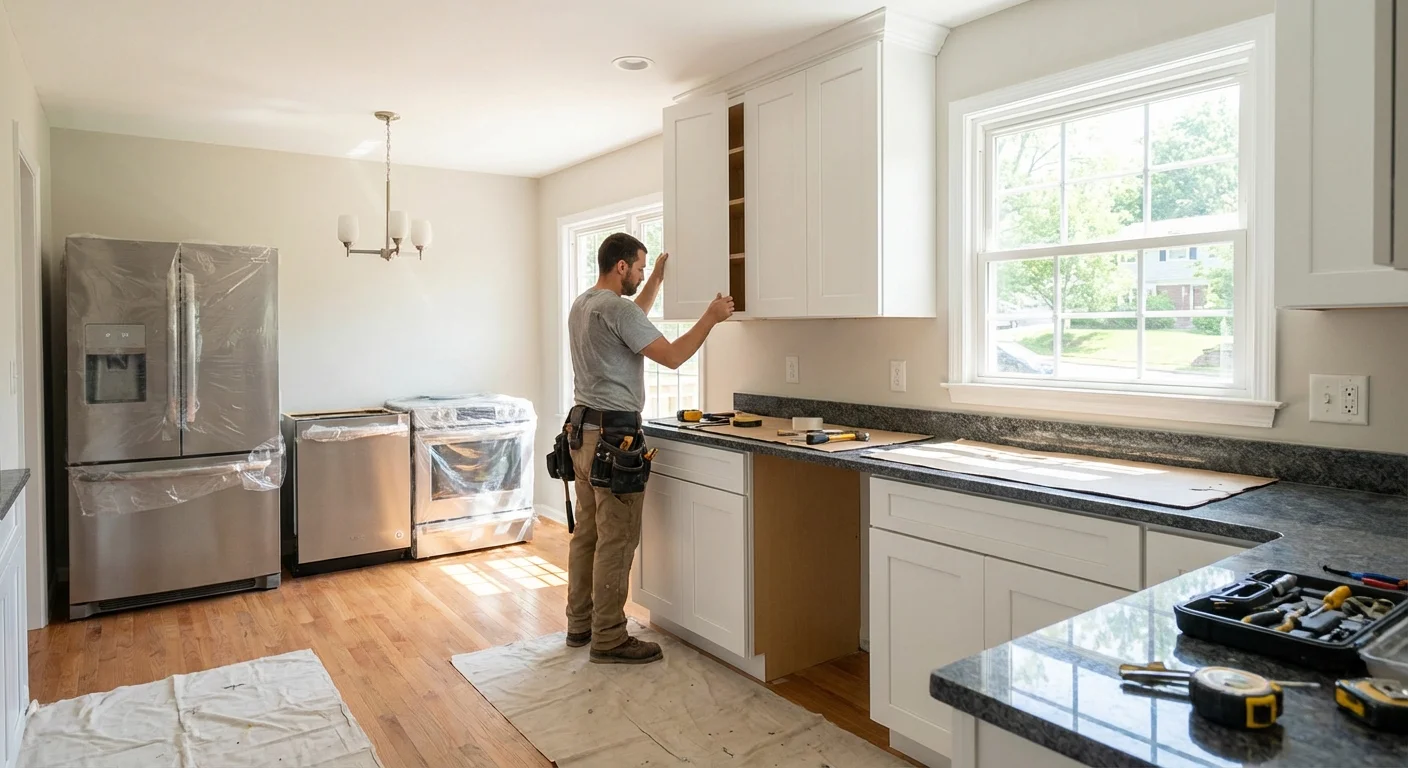
Budget contractors’ estimates plus 15 to 20 percent contingency for unforeseen issues. Hidden mold, structural damage, plumbing problems concealed within walls, and electrical deficiencies frequently require remediation beyond the original scope. A comprehensive home inspection before closing provides critical information. But inspectors cannot identify all potential issues until walls get opened.
Holding Costs Add Up Fast
Holding costs represent ongoing expenses from acquisition through sale. In Montgomery County, property taxes for non-primary residences typically run $133 to $183 per month on a $250,000 property. Insurance for an investment property under renovation averages $150 to $300 monthly. Utilities run $200 to $400 monthly. Hard money loan payments on a $175,000 loan at 11 percent interest approximate $1,604 per month.
Monthly holding costs total approximately $2,500 to $3,200. Over a six-month project, that translates to $15,000 to $20,000 before closing costs on the sale. Extended timelines compound this expense rapidly. Every additional month costs real money.
Integrating all components for a first Montgomery County flip: a property purchased at $250,000 with $50,000 renovation budget and six-month holding period requires approximately $170,000 to $190,000 in total capital outlay. A first-time flipper executing a single project realistically needs $80,000 to $100,000 in available liquid capital, with an additional $15,000 to $20,000 held in emergency reserves.
Analyzing Deals and Calculating ARV
Accurate deal analysis separates successful investors from those who repeatedly overpay. The after-repair value, or ARV, estimates what a property will be worth after all renovations complete. Lenders base loan amounts on ARV, making accuracy critical to overall project profitability.
Select three to five recently sold properties within a half-mile radius that share similar characteristics: square footage, lot size, bedroom and bathroom count, and construction year. Properties from different school districts should not be directly compared. School district ratings heavily influence suburban Maryland property values. Each one-point improvement in GreatSchools ratings correlates to approximately 2 to 4 percent property value increases.
Maryland-Specific Adjustments
For size variations, Montgomery County markets typically see $75 to $100 per square foot adjustments. Finished basement space carries roughly 50 percent of the adjustment value of above-grade living space. A fully renovated kitchen can add $15,000 to $35,000 to ARV. Bathroom renovations typically contribute $8,000 to $18,000 per bathroom.
Proximity to Metro stations in Montgomery County can add $25,000 to $50,000 to property values. Make this adjustment for properties within walking distance of transit infrastructure. Apply monthly appreciation rates to comparable sales older than thirty days. Some Montgomery County neighborhoods experience 0.5 to 1.2 percent monthly gains, though appreciation has moderated substantially from pandemic-era levels.
The 70 Percent Rule
Once ARV is established, apply the 70 percent rule to determine your maximum offer. The formula: Maximum Allowable Offer equals 70 percent of ARV minus estimated repair costs. This rule incorporates approximately 30 percent margin for acquisition costs, holding costs, loan fees, closing costs, commissions, and profit.
For a property with $300,000 ARV and $50,000 renovation estimate, the maximum allowable offer would be $160,000. This ceiling protects against overpaying and ensures adequate margin for inevitable unexpected costs. If deal mathematics do not work at this price, walk away. No single deal is worth destroying your profitability.
Financing Options for First-Time Flippers
Hard money lenders represent the financing vehicle of choice for house flippers. These specialized lenders understand fix-and-flip projects and underwrite based on deal potential rather than borrower creditworthiness alone. Interest rates typically range from 9 to 14 percent. Origination points run 2 to 3 percent of loan amount.
A typical hard money loan structure provides financing of 85 percent of purchase price and 100 percent of renovation costs, capped at 70 percent of after-repair value. Loan closing typically occurs within seven to fourteen days of application approval. For first-time flippers competing in Montgomery County’s active market, this speed advantage often proves DECISIVE.
First-time flippers typically require stronger personal financial profiles and may face higher interest rates than experienced operators. Establish relationships with multiple lenders before property identification. Meet with three to five hard money lenders to understand their underwriting criteria, loan terms, and closing procedures. If you want to explore your financing options, you can apply for a loan with no cost and no obligation to see what you qualify for.
Gap Funding for Capital-Constrained Investors
Gap funding involves a two-tiered financing structure where a primary lender provides 70 to 80 percent of after-repair value as the senior lien, while a subordinate lender provides down payment assistance as the junior position. This structure preserves investor capital for multiple projects by eliminating the need to exhaust personal savings for down payments.
Building Your Team
Successful house flipping depends less on individual investor acumen than on team quality. First-time flippers frequently prioritize lowest-cost options and learn painful lessons about rework, delays, and cost overruns. Building a reliable team before identifying properties accelerates deal execution.
Finding reliable contractors represents the most critical team component. Most successful flippers identify and vet at least three potential general contractors before beginning active acquisition. Begin searches through word-of-mouth referrals from fellow investors, real estate agents, and local investment groups. Online platforms like HomeAdvisor and Thumbtack provide listings with reviews, though independent verification of references remains essential.
Contractor Payment Structure
Standard practice involves 10 percent down upon contract signing, 25 percent at rough-in completion, 25 percent at substantial completion, and 40 percent final payment upon completion and cleanup. This structure holds 40 percent of contractor fees until project completion, incentivizing thorough final work before payment. Weekly progress meetings maintain momentum and address issues before small problems become expensive delays.
Finding an investor-friendly real estate agent proves equally critical. This agent represents your primary market intelligence source and handles both acquisition and resale transactions. Look for agents specializing in working with real estate investors who demonstrate solid understanding of local market trends. Interview potential agents about their experience with investor properties specifically.
Renovation Priorities That Matter to Buyers
Maximizing resale value requires understanding what Montgomery County buyers actually prioritize. Kitchen renovations remain the single highest-impact improvement. Modern, high-performance appliances have become a significant focus for today’s buyers. Premium brands like KitchenAid, Sub-Zero, and Bosch create kitchens that blend professional functionality with sophisticated aesthetics.
But midrange kitchen renovations typically deliver superior return on investment compared to upscale versions. A midrange kitchen averaging $40,000 to $50,000 generates approximately 70 to 85 percent ROI. Upscale kitchens averaging $72,000 generate only 58 percent ROI. The broader buyer pool proves more price-sensitive than the ultra-luxury segment.
Bathroom renovations rank just behind kitchens. Walk-in showers, double vanities, and strategic lighting all contribute to appeal. Water-efficient fixtures hold particular appeal to environmentally conscious Montgomery County buyers. Midrange bathroom remodels generate 72 percent return on investment.
Curb Appeal and Energy Efficiency
Curb appeal provides the first impression affecting buyer interest. Manufactured stone veneer, new siding, steel entry doors, and well-maintained roofing consistently deliver highest returns among exterior improvements, often exceeding 90 percent. These improvements cost significantly less than interior renovations yet command disproportionate returns.
Energy efficiency upgrades hold particular appeal in Montgomery County. Enhanced insulation, energy-efficient windows, high-efficiency HVAC systems, and solar panels all contribute to buyer appeal. In older homes throughout Kensington and Chevy Chase, energy efficiency upgrades appeal to sophisticated buyers willing to pay premiums for modernized systems.
Holding Costs, Taxes, and Common Mistakes
Holding costs represent the primary profit killer for inexperienced flippers who underestimate duration and complexity. These expenses continue regardless of property occupancy or renovation status, accumulating daily and directly reducing returns. Managing holding costs requires aggressive timeline discipline and contingency planning.
When bidding projects to contractors, specify tight deadlines and include completion penalties that motivate adherence. Establish project milestones with specific dates for permit approvals, rough-in completion, final inspections, and completion. Monitor progress actively through weekly site visits. Permit delays represent a common source of extended holding periods.
Tax Considerations
Properties held less than one year face ordinary income tax rates up to 37 percent federal plus state taxes rather than capital gains rates. A $30,000 project profit can reduce to $18,000 after federal and state taxes plus self-employment taxes. Maryland real estate transfer taxes must be paid on the resale. Montgomery County charges $8.90 per $1,000 for loans up to $500,000. Accounting for these liabilities in deal underwriting prevents post-project disappointment.
Common Beginner Mistakes
Overpaying for properties ranks among the most prevalent errors. First-time flippers often get emotionally attached and override numerical discipline. The antidote is strict adherence to the 70 percent rule. If the math does not work at maximum allowable offer, walk away.
Taking DIY approaches to technical systems represents another widespread mistake. While painting and cosmetic improvements suit DIY work, anything involving plumbing, roofing, electrical, or HVAC requires licensed professionals. DIY work often requires expensive remediation to correct code violations. The cost of professional work done once correctly proves substantially lower than DIY work requiring professional rework.
Overpricing for sale represents the final critical mistake. After investing substantial capital and effort, flippers often set asking prices higher than market evidence supports. Properties priced excessively sit on market for months, accumulating carrying costs and eventually forcing price reductions anyway. Price competitively from day one.
Exit Strategies When Plans Change
Most flip projects are structured for quick resale. But market conditions or property characteristics occasionally dictate alternative strategies. Understanding these options before distressed situations force decisions enables sophisticated portfolio management.
The traditional sale to a retail buyer remains standard. Experienced flippers executing this strategy typically achieve three to six month holding periods. When market conditions soften or properties take longer to sell, extended holding periods compress profits through accumulated carrying costs.
Rental Hold as Backup
Buy-and-hold exit strategy enables converted flips to generate ongoing cash flow while awaiting better market conditions. A flipper who finishes renovation during market slowdown might refinance, pull cash out, and rent the property until the sales market improves. In Montgomery County’s strong rental market, properties can generate positive cash flow of $500 to $1,500 monthly even during economic downturns.
The BRRRR strategy (Buy, Rehab, Rent, Refinance, Repeat) represents a systematized variation enabling portfolio growth without perpetual capital infusions. Investors buying distressed properties, rehabilitating to value-add level, renting to tenants, and refinancing at post-improvement values create leveraged wealth-building engines.
1031 Exchanges
1031 exchanges allow investors to defer capital gains taxes when reinvesting proceeds into like-kind investment property. Maryland conforms to federal 1031 exchange rules. After property sale, you have forty-five days to identify replacement property and one hundred eighty days to complete acquisition. A qualified intermediary must hold proceeds during this period. While complex to execute, 1031 exchanges enable experienced flippers to grow portfolios systematically without triggering annual capital gains taxes.
The critical lesson for all exit strategies centers on maintaining flexibility within financial discipline. Before acquiring any property, identify realistic alternatives beyond your primary resale strategy. Can the property work as rental if resale complications arise? Building contingency plans before complications force reactive decisions protects against cascading mistakes.
The Complete First-Time Flipper Checklist
Print this out. Tape it to your wall. Check off each item as you complete it. Skipping steps is how first flips go sideways.
Phase 1: Pre-Search Preparation
- Confirm $80,000 to $100,000 in liquid capital available
- Set aside $15,000 to $20,000 in emergency reserves (do not touch)
- Meet with 3 to 5 hard money lenders and get pre-qualified
- Interview and select an investor-friendly real estate agent
- Identify and vet at least 3 general contractors
- Establish relationship with a closing attorney
- Find an accountant familiar with real estate investing
Phase 2: Market Research
- Select 2 to 3 target neighborhoods in Montgomery County
- Drive target neighborhoods at different times of day and week
- Research school district ratings for target areas
- Check Metro station proximity and transit accessibility
- Pull recent comparable sales (last 90 days) in target neighborhoods
Phase 3: Deal Analysis (For Each Property)
- Find 3 to 5 comparable sold properties within half-mile radius
- Calculate after-repair value (ARV) using conservative comps
- Get contractor bids for renovation scope
- Add 15 to 20 percent contingency to renovation estimate
- Apply 70 percent rule: (ARV x 0.70) minus repairs = max offer
- Walk away if numbers do not work at max allowable offer
Phase 4: Pre-Closing Due Diligence
- Order comprehensive home inspection
- Consult Montgomery County Permitting Services about required permits
- Verify no historic district restrictions (CHAP)
- Check for HOA rules that could affect renovation or resale
- Confirm property can work as rental if resale fails (backup exit)
- Finalize hard money loan terms and lock in financing
- Secure investment property insurance quote
Phase 5: Renovation Execution
- Call 811 at least 2 days before any digging
- Pull all required permits before work begins
- Execute contractor agreement with payment milestones (10/25/25/40)
- Verify contractor license and insurance are current
- Post permit on site with lot number visible
- Schedule weekly progress meetings with contractor
- Prioritize kitchen, bathrooms, and curb appeal upgrades
- Schedule close-in inspections (building, electrical, mechanical together)
- Pass all final inspections before listing
Phase 6: Sale Preparation
- Complete final punch list items
- Deep clean entire property
- Stage property or arrange virtual staging
- Take professional listing photos
- Price competitively based on current comps (do not overprice)
- List property and execute marketing plan
Phase 7: Post-Sale
- Pay off hard money loan at closing
- Calculate actual profit versus projected profit
- Document lessons learned for next project
- Set aside funds for tax liability (up to 37% federal plus state)
- Consider 1031 exchange if reinvesting proceeds
Your First Flip Starts With Preparation
Montgomery County presents compelling opportunities for disciplined first-time investors willing to master the technical and operational complexities of flipping. The state’s exceptional market fundamentals combine with affluent demographics and consistent appreciation to create an attractive investment backdrop. But realizing these opportunities requires understanding that success comes from preparation, not luck.
Your first flip will be a learning experience. Expect modest returns compared to experienced operators while you build expertise and contractor relationships. Most importantly, complete your first flip successfully. Extract lessons. Systematize processes. Build relationships that enable subsequent projects to progress more smoothly with improved profitability. The flippers generating $150,000 or more in annual profits all started with single projects executed imperfectly but thoroughly.
If you are ready to explore financing for your first Montgomery County flip, submit a loan application with no cost and no obligation. Understanding your financing options early helps you move quickly when the right deal appears. And in this market, speed matters.